

Hand Engraving
in Haute Horlogerie
in Haute Horlogerie
Hand Engraving in Haute Horlogerie
In the rarefied world of haute horlogerie, hand engraving is not an embellishment — it is an assertion of permanence. It is the silent dialogue between artisan and metal, where time itself is framed by human touch. Each incision is deliberate, each flourish the result of mastery honed over decades. Unlike mechanical precision, which can be replicated, engraving preserves the singular gesture of the engraver — an unrepeatable signature rendered in steel, gold, or German silver.
For the most discerning collectors, a hand engraved watch represents the convergence of mechanical complexity and artistic devotion. Beneath sapphire crystal and within the architecture of the movement, engraving transforms functional components into sculptural expressions of light and shadow. It is here that craft transcends decoration and becomes heritage.
Hand engraving in watchmaking belongs to a lineage that predates industrialization. Long before CNC machining and laser etching, the surfaces of pocket watches and marine chronometers were enriched by master engravers who shaped metal with burins under magnification. In haute horlogerie, this tradition endures not as nostalgia, but as a commitment to uncompromising craftsmanship.
True hand engraving is performed without automated assistance. No pantograph, no laser, no computer-guided incision. The artisan works at a traditional engraving bench, guiding sharpened gravers across the metal surface under a microscope or high-power loupe. Each cut removes material permanently; there is no possibility of correction. The margin between brilliance and irreversibility is measured in microns.
The aesthetic language of engraving may vary — floral arabesques, architectural scrolls, baroque reliefs, geometric guilloché-inspired motifs, or contemporary minimalism — yet its purpose remains constant: to elevate mechanics into art.
Technical Foundations of Engraving Materials and Substrates In haute horlogerie, engraving is typically executed on:
The engraver must understand hardness (measured on the Vickers scale), grain structure, and internal stress patterns to avoid microfractures or surface distortion. |
Tools and Methodology The foundation of hand engraving lies in the burin — a hardened steel cutting tool shaped to specific geometries:
The engraving process involves: 1. Surface preparation – bridges are beveled, polished, and rhodium-treated (if applicable) before engraving begins. 2. Design transfer – motifs are either drawn directly onto the metal using lacquer-based inks or transferred via traditional tracing techniques. 3. Primary cutting – deep structural lines establish the composition. 4. Relief modeling – background material is gradually removed to raise the motif. 5. Texturing – matte backgrounds are created using stippling or fine punch techniques. 6. Final finishing – polished bevels (anglage) are reworked by hand to restore mirror brilliance. Unlike stamping or chemical etching, hand engraving produces cuts with faceted walls that reflect light dynamically. Under magnification, the difference is unmistakable: the cut reveals microscopic striations unique to the artisan’s movement. |
Within a high-complication calibre, bridges serve both structural and aesthetic functions. They stabilize gear trains, anchor jewels, and define the architecture of the movement. When executed as engraved movement bridges, these components become the canvas of haute horlogerie.
Structural Integrity and Engraving Depth
Engraving a bridge requires precise calculation. Excessive material removal may compromise rigidity or alter torque distribution across the train. For this reason:
- Maximum engraving depth typically ranges from 0.05 mm to 0.20 mm, depending on bridge thickness.
- Stress concentration zones — near jewel settings or screw apertures — are avoided.
- Finite structural tolerances are respected to preserve chronometric performance.
Engraving does not exist in isolation. It interacts with:
- Côtes de Genève striping
- Perlage on the mainplate
- Black-polished steel components
- Hand-beveled interior angles
The interplay of surfaces is essential. Light must transition seamlessly from engraved recess to polished edge, producing depth without visual excess.
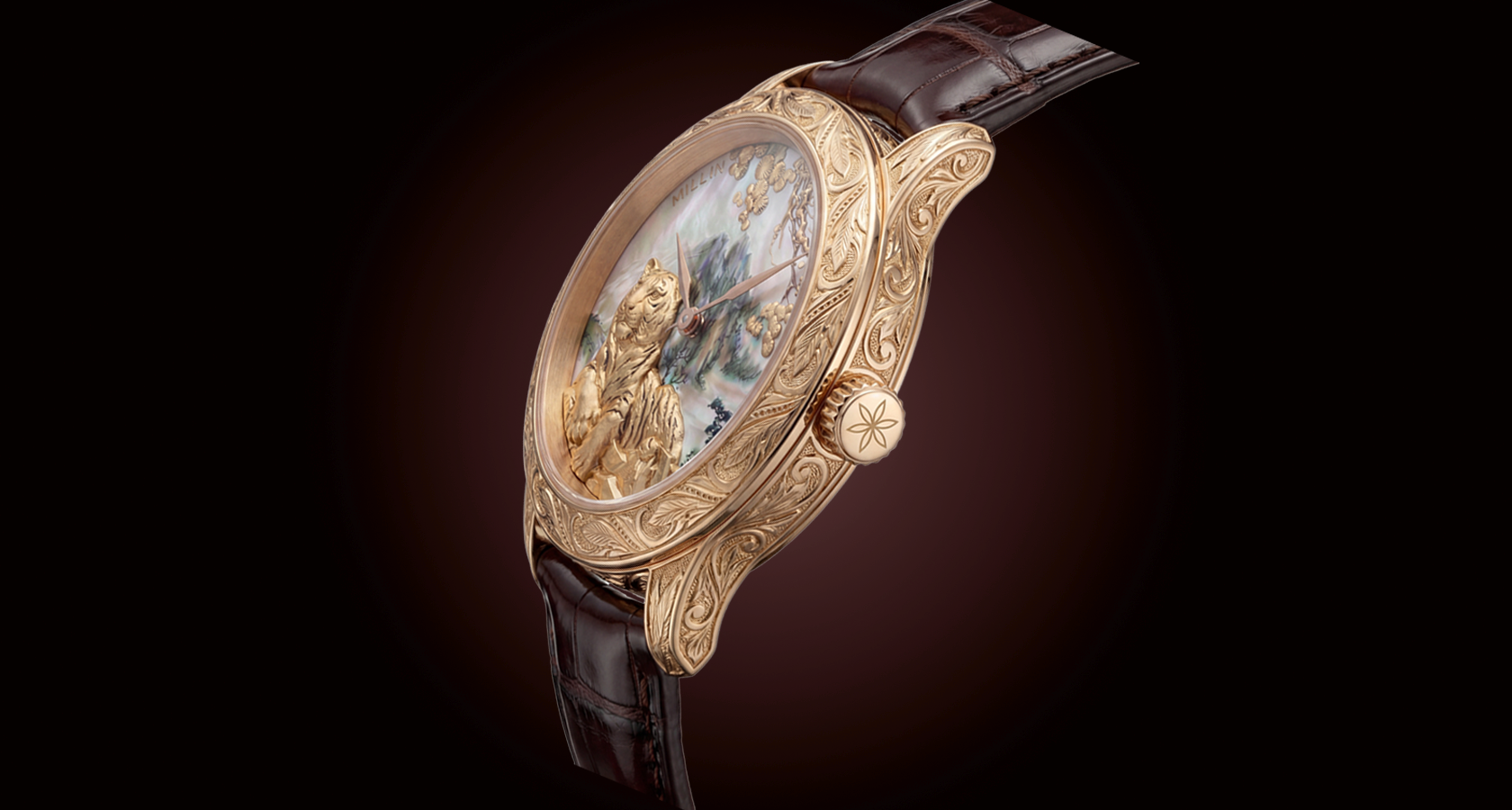
Beyond the movement, engraving may extend to the case, bezel, lugs, or even the dial flange. Case engraving presents additional technical complexities:
- Curved surfaces require rotational control of the vice.
- Polished gold cases demand uniform cut depth to preserve symmetry.
- Platinum’s density necessitates increased cutting pressure and frequent tool sharpening.
A hand engraved watch case can require 80 to 200 hours of artisanal labor, depending on motif density and relief depth.
Relief Engraving vs. Line Engraving
Two principal engraving styles define haute horlogerie:
Line Engraving
- Emphasizes delicate scrollwork
- Typically 0.05–0.10 mm deep
- Relies on contrast and negative space
- Background material removed extensively
- Motif rises above matte surface
- May require multi-stage sculpting
- Time investment significantly higher
Time Investment and Human Precision
A single engraved balance cock may require 20–40 hours of work. Fully engraved movement bridges for a high-complication calibre can demand 150–300 hours. Complete case engraving may double that figure.
Every hour is cumulative precision. Under 10× to 20× magnification, the artisan guides the burin through curves measured in fractions of a millimeter. The rhythmic cadence of cutting — pressure, release, advance — becomes almost meditative.
No algorithm replicates this cadence. The slight variance in pressure creates a vitality impossible to simulate. For collectors, this vitality is the essence of authenticity.
Preservation of Chronometric Integrity
Haute horlogerie tolerates no compromise in performance. After engraving, each component undergoes:
- Dimensional verification
- Surface stress inspection
- Ultrasonic cleaning
- Reassembly and regulation
Amplitude, beat error, and positional variation are recalibrated to ensure that aesthetic intervention has not altered mechanical equilibrium.
Thus, engraving becomes an invisible enhancement — it elevates beauty without diminishing precision.
Heritage and Transmission
The art of engraving is transmitted through apprenticeship. Master engravers train for years before entrusted with movement components. Unlike industrial finishing, engraving cannot be accelerated by machinery. Skill is accumulated, not programmed.
Each engraved calibre becomes a testament to generational continuity — a mechanical archive of artisanal lineage.
The Collector’s Perspective
For connoisseurs, engraved movement bridges reveal themselves only upon turning the watch. It is a private revelation — an intimate encounter between owner and mechanism.
A hand engraved watch does not proclaim luxury; it whispers permanence. Its value lies not in spectacle but in devotion — measured in hours of human focus rather than production volume.
Engraving ensures that no two pieces are ever entirely identical. Even within a limited series, microscopic variations render each watch singular.
Contemporary Relevance
In an era of additive manufacturing and digital precision, hand engraving remains deliberately analog. Its relevance lies precisely in its resistance to automation. It preserves the human dimension within mechanical perfection.
As haute horlogerie continues to explore advanced materials and technical innovation, engraving anchors the discipline to its artistic foundations. It reminds us that timekeeping, at its highest expression, is not solely about accuracy — it is about meaning.
Conclusion
Hand engraving in haute horlogerie represents the convergence of engineering, sculpture, and devotion. Whether expressed through engraved movement bridges, sculpted balance cocks, or a fully hand engraved watch case, it transforms mechanical architecture into enduring art.
Each cut is irreversible. Each surface reflects not only light, but lineage. And within every engraved calibre resides a quiet truth: time may be measured by gears and springs, yet its beauty is shaped by the human hand.
