

© 2026 The House of MILLIN
Elegant Crane
Rare techniques of
hand engraving
and hot enameling
Rare techniques of
hand engraving
and hot enameling
ELEGANCE IN FEMININITY
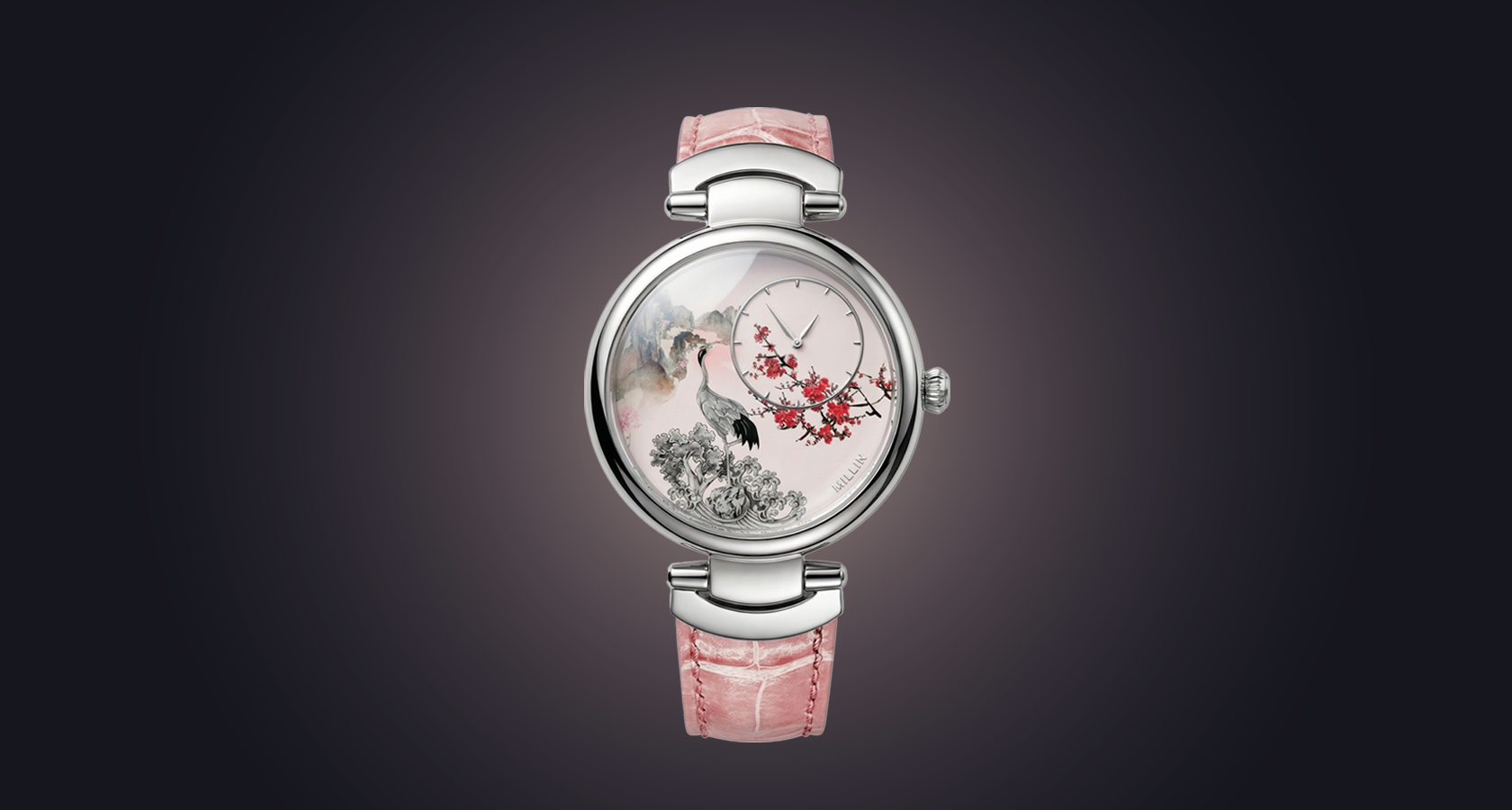
The Graceful Crane women's watch is crafted in a multifaceted, mysterious composition of several figures,
revealing its design not at first glance.
The work is executed using hand engraving. The exquisite finish of the gold dial is achieved with enameling, using multiple layers of translucent enamel.
At the intersection of horology and rare artisanal techniques.
NEW FROM THE HUA-NYAO GENRE COLLECTION
Elegant Crane
The crane is one of the most common motifs in Hua-Niao genre paintings.
Like pines and rocks, the crane symbolizes longevity as well as wisdom. The character 鹤 (pinyin: hè, “crane”) is a homophone for the character 合 (pinyin: hé, “peace, harmony”).
Embroidery featuring cranes was part of the insignia of high-ranking imperial officials [9]. The character 鹳 (pinyin: guàn), used to denote both storks and cranes, is a homophone of 官 (pinyin: guān, “official”) and 冠 (pinyin: guàn, “to attain the highest rank”), so an image of a crane can symbolize the aspiration to reach the highest official position.
The crane (鹤, hè) and the lotus (荷, hé), when depicted together, represent a wish for peace and harmony (和, hé), as all three characters are also homophones.
Typically, the crane is depicted standing alone on one leg in the tidal waters, which can also be interpreted as a visual pun, since the characters 潮 (pinyin: cháo, “tide”) and 朝 (pinyin: cháo, “dynasty, imperial court,” as well as “to have an audience with the emperor”) are pronounced the same way.
An image of a crane standing in tidal waters represents a high-ranking official attending an audience with the emperor. A crane standing on a rock symbolizes the official achieving the highest rank. Moreover, the expression 独立 (pinyin: dúlì, “standing independently”) is a homophone of another character combination 独力 (pinyin: dúlì, “by one’s own effort, independently, without outside help”), so the depiction of a solitary crane symbolizes an official who successfully passed the state examinations for a position in the high-ranking bureaucracy and attained their prestigious title through diligent study.
Like pines and rocks, the crane symbolizes longevity as well as wisdom. The character 鹤 (pinyin: hè, “crane”) is a homophone for the character 合 (pinyin: hé, “peace, harmony”).
Embroidery featuring cranes was part of the insignia of high-ranking imperial officials [9]. The character 鹳 (pinyin: guàn), used to denote both storks and cranes, is a homophone of 官 (pinyin: guān, “official”) and 冠 (pinyin: guàn, “to attain the highest rank”), so an image of a crane can symbolize the aspiration to reach the highest official position.
The crane (鹤, hè) and the lotus (荷, hé), when depicted together, represent a wish for peace and harmony (和, hé), as all three characters are also homophones.
Typically, the crane is depicted standing alone on one leg in the tidal waters, which can also be interpreted as a visual pun, since the characters 潮 (pinyin: cháo, “tide”) and 朝 (pinyin: cháo, “dynasty, imperial court,” as well as “to have an audience with the emperor”) are pronounced the same way.
An image of a crane standing in tidal waters represents a high-ranking official attending an audience with the emperor. A crane standing on a rock symbolizes the official achieving the highest rank. Moreover, the expression 独立 (pinyin: dúlì, “standing independently”) is a homophone of another character combination 独力 (pinyin: dúlì, “by one’s own effort, independently, without outside help”), so the depiction of a solitary crane symbolizes an official who successfully passed the state examinations for a position in the high-ranking bureaucracy and attained their prestigious title through diligent study.
TECHNICAL SPECIFICATIONS
The case, bezel, case back, and clasp are made of 18-carat white gold.
Case diameter: 38 mm, thickness: 10 mm.
Protection against moisture and dust only (not waterproof).
Sapphire crystals on the bezel and case back.
Case diameter: 38 mm, thickness: 10 mm.
Protection against moisture and dust only (not waterproof).
Sapphire crystals on the bezel and case back.
The dial painting is done with paints and features a multilayered hot enamel finish. The dial plate, along with the Crane appliqué, is made of 18-carat gold.
The hour and minute hands are spear-shaped, made of gold, and feature hand engraving.
The hour and minute hands are spear-shaped, made of gold, and feature hand engraving.
Swiss manufacture caliber
Diameter: 23.30 mm
Height: 3.90 mm
Hours, minutes, central seconds hand
Time setting via the seconds hand
Automatic winding movement
Frequency: 28,800 semi-oscillations per hour; 4 Hz
Number of jewels: 28
Number of components: 189
Chamfers, recesses, and holes polished with diamond
Bridges beveled by hand
Typical power reserve: 50 hours
Diameter: 23.30 mm
Height: 3.90 mm
Hours, minutes, central seconds hand
Time setting via the seconds hand
Automatic winding movement
Frequency: 28,800 semi-oscillations per hour; 4 Hz
Number of jewels: 28
Number of components: 189
Chamfers, recesses, and holes polished with diamond
Bridges beveled by hand
Typical power reserve: 50 hours
Diamond-patterned alligator leather strap, hand-stitched.
Folding clasp in white gold with hand engraving.
Folding clasp in white gold with hand engraving.
OTHER WATCHES
Book a Private Appointment
Kindly complete the form below, and our team will be delighted to contact you to arrange a call or private appointment at your convenience.
MILLIN WATCH HOUSE
Contact Us
for Inquiries
for Inquiries
